


Al Garcia
dance artist
performance maker

AL GARCIA (賈西亞)
AL (b. 1991) is a Filipino dance artist and educator currently based in Taiwan. He holds an MFA in Dance from Nanhua University, where he was honored with the 2024 Distinguished Alumni Award for Culture and the Arts. He is also the recipient of the AET Koryograpika Biennale Award for 2024. His work LIMBO was showcased at the 2024 Dance Now Asia festival in Taipei, Taiwan. He won first prize in the 2012 Wifi Body New Choreographers’ Competition (Philippines) and presented his work at the 2013 Yokohama Dance EX (Japan). AL develops dance education programs in the Philippines and actively contributes to the Cultural Center of the Philippines' choreographers and dance platforms. Passionate about intercultural exchanges and collaborations, he promotes Philippine art and culture through his works. As a diasporic artist, he explores themes of migration, displacement, and cultural navigation in his artistic endeavors.


"I want to show the audience that our roots should never be forgotten. Our heritage should no longer be looked at as museum pieces that cannot be touched or experienced. I want to show that new art can humanize and contextualize our Filipino roots. My work is a reminder of the richness of our heritage. I don't intend to recreate tradition but I want to create works that are strangely familiar yet new. I want to create curiosity about our roots.". And so it seems to me that what started as an interest in folk dance has became a personal advocacy in favor of the Filipino.
Works and Press Coverage
AL Garcia’s LaoWaiLao 老外勞
by BJ Crisostomo
October 23, 2023

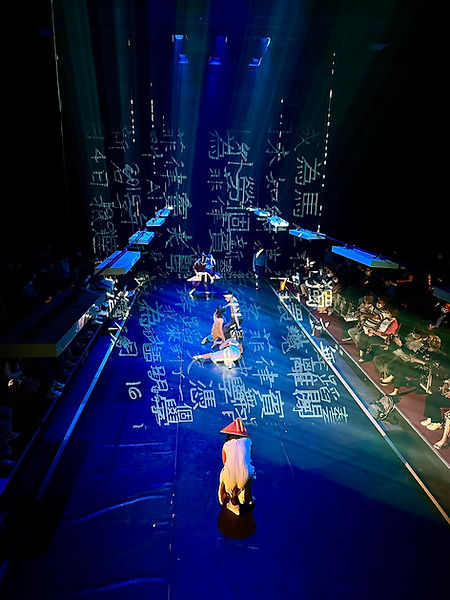
Al Garcia’s LaoWaiLao is a total performance which utilized movement, choreography, sound, light, prop and technology as elements to articulate the difficulties of the Filipino dancer’s diasporic journeys.
Upon viewing, it was incredibly easy to resonate with the struggles of identifying dance (in extension, performance art) as a profession in today’s commodified creative landscape. Particularly telling was the call which the audience got to eavesdrop via QR code where the choreographer himself expounds on the difficulty of working and studying abroad in order to bulk up his portfolio. “Alam mo naman sa industriya natin, papel ang labanan.” The dancer must leave the comforts of his homeland and venture into foreign territory to establish his identity as Artist, capital A.
This is a sobering fact in our neocolonial reality, local education and experience seem to pale in comparison to its foreign counterparts. Is this because local training is somewhat lacking or are we still nostalgic of our colonial chains? Whatever the case, working/ practicing/ studying/ joining competitions abroad is a popular option for the Filipino artist. The piece masterfully intimated feelings of homesickness, isolation, and struggle through its exposition.
At this point I must admit there was a short-circuit of sorts when it came to dealing with the aforementioned problematics. How did the persona of the diasporic dancer in neon orange boots overcome his problems? Perhaps I missed something while watching the piece, but exposition seemed to jump to resolution, a heartrending one at that.
At the end, the dancer comes home— a chorus ritualized a round dance, folk in gesture, childish in repetition, reminiscent of simpler times. This chorus moved to the curtains where I could only see their feet continuously jumping about through the backlight, a particularly moving image which evoked feelings of returning to roots or longing as we voyage further away from home.
AL Garcia’s BBYLN
by Joelle Jacinto
Dec 5, 2021

This is apparently the beginning of his BBYLN, a work of contemporary dance created as his thesis for an MFA at Nanhua University. “BBYLN” stands for babaylan, written out according to its original spelling, given that pre-modern Filipino scripts did not use vowels or lower case letters. A babaylan is a shaman, part medicine worker and part spiritual leader and medium; in ancient Filipino communities, the babaylan had an equal standing to the datu or king, and the panday or metalsmith, who forges weapons and musical gongs. Usually, the babaylan is a woman, with the belief that only a woman is able to communicate with spirits and deities. When a man becomes a babaylan, he must change his entire being, not only his appearance but also his behaviour, mannerisms, way of thinking, and intuitiveness, into that of a woman.
Syncretic Choreography in Philippine Dance Theater: Danced Narratives of Interstitiality and Kapwa
2019, Journal of English Studies and Comparative Literature
by Regina Bautista

Garcia’s structuring of the dramatic plot of Tau-luwa piece is inspired by his knowledge of Philippine myths, particularly the narrative convention of life cycles. The structure of presenting a life through the depiction of courtship, marriage, birth, and death was always present in the folk dance narratives he learned as a folk dancer. Thus, the storyline of his piece can be said to be conversant with Philippine myths and rituals.
Through the practice of embodying performative traditions, Garcia recognized the possibilities and limitations of the recreation and interpretation of folk dances (A. B. Garcia, personal communication, September 29, 2016). He insisted on describing his community as “imagined” because he anticipated the dangers of representation. Thus, he made it a point to acknowledge that his piece is a mixture of both the T’boli and Subanen indigenous groups’ dance culture. The title Tau-Luwa is his play on the words Tao (Person) and Kaluluwa (Spirit/Soul).
Artist Feature: Al Bernard Garcia
January 5, 2017
by Erica Jacinto

His journey as a choreographer is a beautiful one because at a young age he has had the chance to learn from both local and international artists. Enriched by opportunities to create works of art and opportunities to witness art within the dance community developed his choreographic skill. Last September, he earned a spot in Ballet Philippines' "Bagong Sayaw". His latest creation which we discussed heavily in the videoclip is his first major work for a ballet company, performed in no less than a respective cultural institution. When asked why he chose a theme so intrinsically Filipino and far from the So You Think You Can Dance genre so popularly loved, his answer was clear. It was his first major body of work and he felt that he needed to share with his audience something that he felt was close to him. In his resolve not to show anything underdeveloped he went back to his roots and found his voice where he started. He took another look at his thesis and research on Filipino Tribes and ethnic culture and decided to take another shot at creating something Filipino. This time his intention was more solid. So what was his intention? In his own words he says, "I want to show the audience that our roots should never be forgotten. Our heritage should no longer be looked at as museum pieces that cannot be touched or experienced. I want to show that new art can humanize and contextualize our Filipino roots. My work is a reminder of the richness of our heritage. I don't intend to recreate tradition but I want to create works that are strangely familiar yet new. I want to create curiosity about our roots.". And so it seems to me that what started as an interest in folk dance has became a personal advocacy in favor of the Filipino.
Garcia’s Purposeful Simplicity
(MANILA TIMES: Rite of Passage, Ballet Philippines' "Bagong Sayaw")
September 16, 2016
by Erica Jacinto (Manila Times)
%20-%20photo%20by%20Kurt%20Copon_JPG.jpg)
Garcia was quite the storyteller as he played with courtship, marriage, and family while using the thread of movement. Derived from the words tao and kaluluwa,“Tau-Luwa” explores the connection of tribal faith to the earthly journey of people,at the forefront of which were his principal characters, a man and woman that showed the dynamics of romantic relationships. At one point both characters were joined in a mirage of a pas de deux that used them along in a slow careful process of connecting the couple, until they were finally moving as one person, signifying togetherness and commitment — a marriage — executed through gradually intensifying extensions and lifts.
Gushing Forth: Al Bernard Garcia's Sulog sa Kinabuhi
January 26, 2012
by Joelle Jacinto (RunThru Magazine PH)

As I mentioned in my interview with Al Bernard Garcia about his Sulog sa Kinabuhi, Garcia opted to stage the production in Laguna, home of Mt. Makiling, specifically at the Philippine High School for the Arts, where his dancers, Sanghiyas Pangkat Mananayaw, went to school. The point was to capture the feel of where the Subanen (on whom his dance drama was based) lived and loved; I can imagine that if they were to reenact the building of the buklog tower, which was meant to touch the heavens, a proscenium stage would definitely be inadequate.
They don't build the structure in this restaging (I imagine that such a feat should logistically be a once-in-a-blue-moon affair), but the dancing still takes place outdoors, and must be how the Subanen hold their thanksgiving festival - relaxed, with friends and family chatting animatedly upon arrival, and then with music and dancing.
All Videos

BBYLN (babaylan)

LIMBO

Engkwentro (2022)
